

Between vernacular architecture, iconic megastructures and major cultural projects
A professional journey designed for architects, urban planners and designers
There are journeys that inspire.
And there are journeys that trigger decisions.
Dubai and Abu Dhabi are not cities one visits by chance.
They are territories of observation, where architecture becomes strategy, where urban planning tells a story of power, ambition and identity.
This architectural study trip, designed by Alturis Tours & Events, is dedicated to architects, urban planners, designers, educators and decision-makers who wish to:
deepen their professional reflection
analyze projects at a 1:1 scale
understand how a city is conceived, built, marketed and transformed
A program created by professionals, for professionals, but also perfectly suited for group travel, architectural seminars and inspiration-driven study tours.
Day 1 – Dubai, at its origins: from vernacular trade architecture to the contemporary skyline
(vernacular architecture, traditional souks, historical urbanism, Sheikh Zayed Road)
Bastakiya: architecture shaped by climate and daily life
At dawn, the journey begins where Dubai’s architectural story truly started: Al Fahidi Historical District (Bastakiya).
Having breakfast inside a restored traditional house is not a simple welcome gesture.
It is the first architectural statement of the trip.
Here, architects immediately read:
the human scale of the spaces
the organization around inner courtyards, acting as natural thermal regulators
the thickness of walls made of coral stone, gypsum and lime
the use of palm wood for ceilings
and above all, the iconic wind towers (barjeel), sophisticated bioclimatic devices long before modern sustainability concepts
Bastakiya reminds us of a fundamental truth:
👉 sustainable architecture is not new — it is inherited knowledge.
The souks: traditional commercial architecture and urban density
The walk continues towards Al Fahidi Fort, the Indian Souk, the Old Souk and the traditional markets.
Here, architecture shifts in expression but remains governed by one clear logic: serving trade.
These commercial buildings are:
low-rise
dense
repetitive
organized along narrow circulation paths
This traditional market architecture responds to essential needs:
maximizing shade
encouraging natural ventilation
channeling pedestrian flows
protecting goods from heat
Crossing the Dubai Creek by traditional abra reveals how maritime trade shaped the city’s early urban structure.
Warehouses, markets and commercial streets developed directly along the water, forming a compact and efficient trading city.
On the Deira side, the Gold Souk illustrates modular and repetitive architecture, optimized for intense commercial activity while maintaining natural airflow through constant circulation.
For architects, these souks form an open-air manual of vernacular commercial urbanism.
Contemporary rupture: the Museum of the Future
After this immersion in traditional architecture, the photo stop at the Museum of the Future marks a deliberate and powerful rupture.
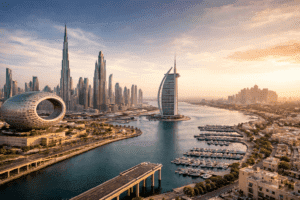
Its elliptical form, parametric structure and stainless-steel façade engraved with Arabic calligraphy redefine the building as a narrative object.
This is not a building that simply hosts a program.
It embodies a vision, where technology, culture and national identity merge.
For architects, it stands as a strong example of iconic contemporary architecture used as urban storytelling.
Sheikh Zayed Road: reading the city in motion
From the Museum of the Future, the journey continues along Sheikh Zayed Road, the backbone of modern Dubai.
This is not a transfer.
It is a moving urban analysis.
The city suddenly changes scale:
vertical density increases
skyscrapers line up as a full-scale architectural catalog
offices, hotels and institutional towers follow the infrastructure
Sheikh Zayed Road reveals a city designed for:
speed
visibility
representation
For architects and urban planners, it is a textbook example of infrastructure-driven urban development.
Arrival at the hotel: a witness of Dubai’s urban history
Arrival at the hotel is itself part of the architectural narrative.
Located with a direct view of the Burj Al Arab, the hotel belongs to a key period in Dubai’s transformation — the moment when hospitality architecture became a strategic tool to position the city on the global stage.
The hotel becomes:
an observation point
a historical witness
a marker of Dubai’s transition from regional port city to global metropolis
After some rest, the day concludes at Dubai Marina, another powerful demonstration of contemporary spectacular urbanism built around an artificial canal.
Dinner aboard a private yacht offers a moment for professional networking and collective reflection:
how did Dubai evolve, in just a few decades, from architecture of necessity to architecture of representation?
Day 2 – Global icons and megaprojects
When architecture becomes strategy, image and power
This day focuses on the projects that propelled Dubai into global architectural consciousness.
Here, every iconic building responds to one fundamental question:
👉 How can architecture position a city on the world stage within a single generation?
Burj Al Arab: building a symbol before building a city
The Burj Al Arab is approached as a landmark case study in iconic architecture.
Built on an artificial island, it raises major technical challenges:
marine foundations
wind resistance and corrosion
complex interaction between engineering and form
Beyond technique, its symbolic function is what fascinates most.
Its sail-shaped silhouette references Dubai’s maritime past while projecting an image of luxury, innovation and ambition.
For architects, it raises a crucial question:
👉 When does architecture stop being a building and become a brand?
Palm Jumeirah: artificial urbanism and the redefinition of territory
From The View at The Palm Jumeirah, the analysis becomes territorial.
The Palm is not a neighborhood.
It is a manufactured geography.
Architects and urban planners study:
land reclamation techniques
soil stabilization
infrastructure built on artificial ground
zoning of residential, hospitality and leisure uses
Palm Jumeirah stands as a laboratory of experimental urbanism, where city-making is driven by vision, feasibility and capital rather than natural constraints.
It inevitably sparks debate:
👉 How far can — or should — a city go in reshaping its environment?
Professional meeting: understanding the decision-making process
The afternoon is dedicated to a professional exchange with local architects and urban development actors.
This moment offers insight into:
how megaprojects are conceived
how decisions are made
how architects, engineers, investors and authorities collaborate
Discussions address:
timelines
climate constraints
profitability
user experience
real sustainability
An open and highly valued exchange for professional participants.
Burj Khalifa: verticality, structure and urban reading
The ascent to Burj Khalifa – Level 148 is both emotional and analytical.
Architects examine:
the Y-shaped structural plan
wind engineering strategies
deep foundation systems
vertical circulation logistics
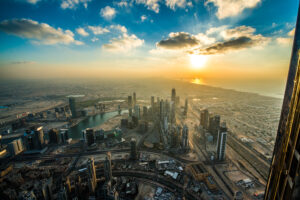
From above, Dubai reveals itself as a composed urban system — a city to be read, not just admired.
Day 3 – Architecture, climate and adaptation
Professional exchanges and reading the desert
After iconic architecture, this day returns to fundamentals: context.
Dialogues with local architects
The morning is dedicated to meetings with architects and urban professionals based in the UAE.
Topics include:
building in extreme climates
managing heat, sand and light
evolving environmental standards
changing user expectations
These exchanges often shift perceptions:
behind spectacle lies continuous technical and climatic problem-solving.
The desert: reading emptiness to understand the city
In the afternoon, departure by 4×4 into the desert.
This radical change of landscape allows a different spatial reading:
emptiness
distance
light
silence
The desert reminds us that all architecture in the Emirates is a response to an extreme environment before it is an aesthetic statement.
The desert camp illustrates an architecture that is:
temporary
lightweight
reversible
perfectly adapted to its context
A powerful counterpoint to urban verticality.
Day 4 – Abu Dhabi
Cultural architecture, power and permanence
Abu Dhabi offers another architectural narrative:
less spectacular, more institutional, and more focused on long-term legacy.
Louvre Abu Dhabi: light as architectural material
The Louvre Abu Dhabi, designed by Jean Nouvel, is a global reference in contemporary museum architecture.
The building unfolds as a contemporary medina, sheltered beneath a vast perforated dome.
Architects analyze:
the dome’s complex geometry
natural light management
spatial sequencing
integration with the maritime site
Here, light does not illuminate architecture.
👉 It becomes architecture.
Sheikh Zayed Grand Mosque: monumentality and spirituality
Visiting the Sheikh Zayed Grand Mosque at sunset offers a sensitive reading of contemporary Islamic architecture.
White marble, symmetry, proportions and refined detailing create a serene monumentality — powerful without excess.
A deeply memorable moment for most participants.
Day 5 – Institutional architecture and national identity
Building power, narrating a nation
The final day explores architecture as a tool of representation and governance.
Qasr Al Watan: monumentality and institutional storytelling
The Presidential Palace Qasr Al Watan is approached as an architectural manifesto.
Symmetry, marble, monumental scale and craftsmanship express:
stability
continuity
national identity
For architects, it is a compelling example of architecture used as political and narrative language.
Saadiyat Island: culture and future vision
The journey continues to Saadiyat Island with a visit to the Sheikh Zayed National Museum.
This final stop connects:
heritage
memory
future projection
It concludes the journey with a key reflection:
👉 how architecture is used to tell the past, define the present and project the future of a nation.
A journey designed to lead to decisions, not just admiration
This architectural study trip to Dubai and Abu Dhabi is designed for:
architectural associations
architecture firms
universities and educators
professional and institutional groups
It can be adapted for:
group travel
professional seminars
architectural inspiration trips
tailor-made programs
👉 This is a journey conceived as a professional tool.